Fretboard Sensei
A guitar practice app with timing-based scoring.
- 197 Commits in 8 days
- 55 Test files
- ~100 Screenshots
fretboard repo, git log, 2026-10-24; fretboard repo, 2026-10-24; fretboard/docs/shots, 2026-10-24
Tap in time
A short phrase on a six-string fretboard. Press play for a count-in, then tap each note by click, touch or keys 1 to 6. Each tap is scored early, late or on time. Sound stays off until you press play.
Problem
Practising guitar to a click is hard to judge by ear. You can feel that you were off, but not by how much, or whether you are early or late. I wanted an app that listens, scores each note against the beat and tells me the offset in milliseconds.
Constraints
- A desktop app, so Electron with React and Vite (fretboard repo, 2026-10-24).
- Audio comes in through the Mac's audio input. The spec assumes a guitar through a USB audio interface, captured with echo cancellation, noise suppression and auto gain all off (fretboard docs/specs, 2026-09-29).
Approach
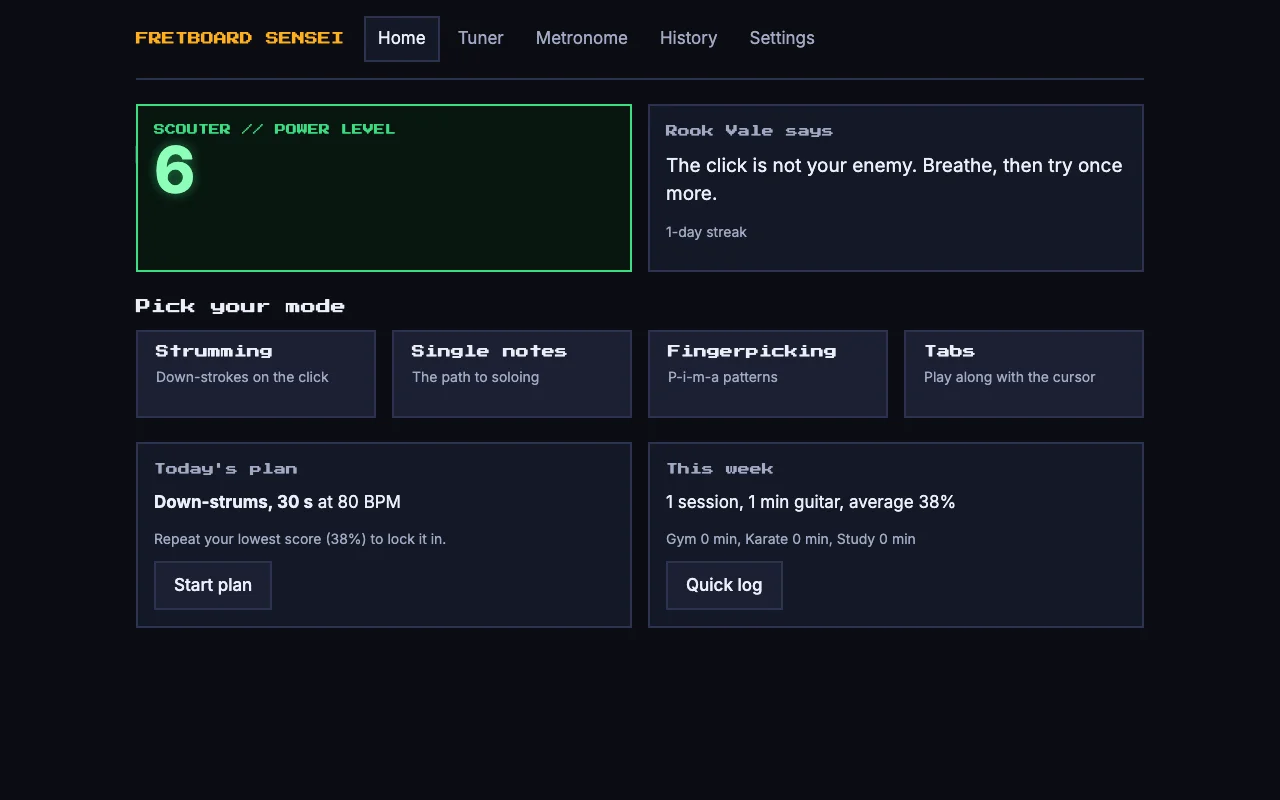
The app is organised around practice modes: strumming, single notes, fingerpicking and tabs. Each exercise has a tempo and a fixed length. For example, down-strums for 30 seconds at 80 BPM.
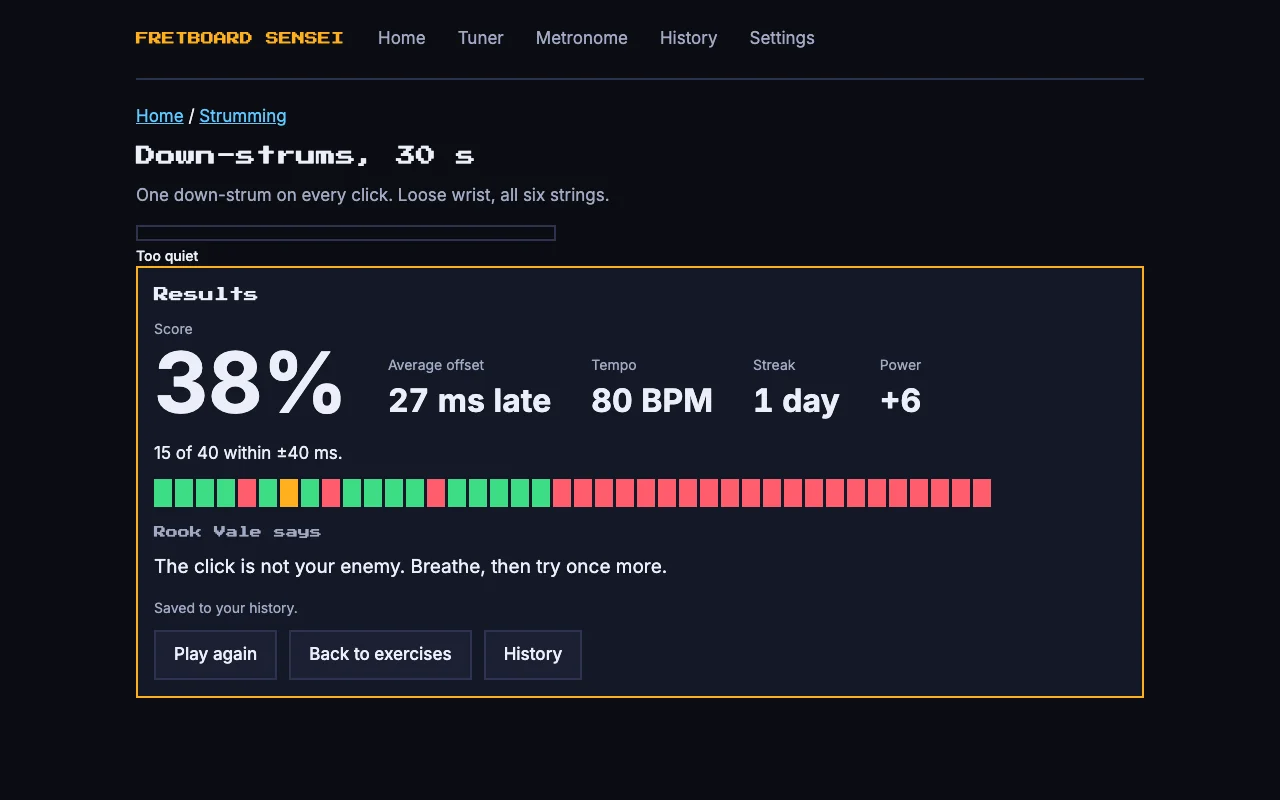
Scoring is timing-based. Every expected beat has a window of 40 ms either side. A hit inside the window counts, and the result screen shows how many of the beats landed, the average offset and the tempo. It also shows a strip of per-beat marks, so you can see where in the run you drifted.
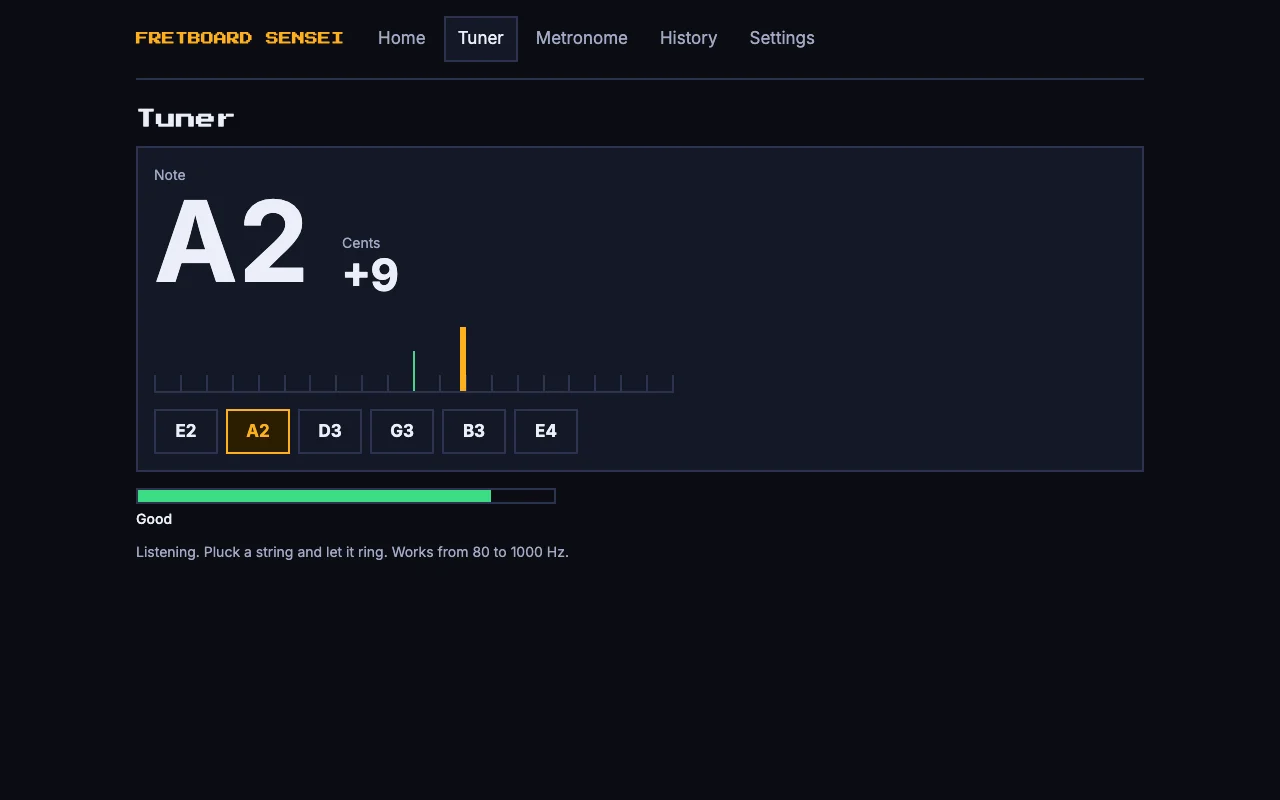
There is a tuner for the six open strings, a metronome, a history view and settings. A coach line on the home screen and results screen gives one short sentence. A power level and a day streak track progress.
The tests are Vitest for logic and Playwright for the app itself (fretboard repo, 2026-10-24).
What shipped
- Four practice modes with timing-based scoring.
- A results screen with score, average offset, tempo, streak and a per-beat strip. In the screenshot below, 15 of 40 beats landed within 40 ms, for a score of 38%.
- A tuner for the six open strings, with a cents readout.
- A metronome, session history, a daily plan and a quick log.
The screenshots come from the repo's docs/shots/ folder.
Outcome
The repo has 197 commits between 2026-09-29 and 2026-10-06 (git log, fretboard repo, 2026-10-24), an eight-day burst. It has 277 tracked files and 55 real test files (fretboard repo, 2026-10-24). The repo holds about 100 screenshots, taken at 1280 and 560 pixels wide.
Acceptance contracts and UAT reports for the build sit in a separate private repo, apart from the app code.
Status: prototype, in progress. It was built as a release candidate in eight days and installed as a Mac app. Its timing tests and blind UAT passed with no P1 or P2 issues on 2026-10-05, but my own sign-off with the guitar and the audio interface was still open on 2026-10-07 (vault Dev Log 2026-10-05).
What I learned
My first read of the timing problem was wrong. A run showed about 47 ms of drift. The builder called it an environment issue, but triage treated it as a product bug. The real cause was audio device changes, not machine load, and I confirmed that by measuring before and after the fix. The first builds also failed my own hardware test, because they ran as Chrome tabs and bounced in the Dock for five minutes. Both apps became proper Electron apps after that (vault One Year Plan decision table, Dev Log 2026-10-05).
How AI built this
Fretboard Sensei was built in eight days with Claude Code agents.
- Models. Opus was the controller and reviewer, and Sonnet agents were the implementers.
- Code-blind tests. Written from contracts by agents that never saw the code: a UI-conformance suite (62 tests, Opus tester) and a functional suite (42 tests, Sonnet tester). A blind G4 review found 0 Critical, 4 Important and 13 Minor issues, followed by a code-blind computer-use UAT. The repo's own 55 test files were written by the builders and are not code-blind.