Dojo
A local-first macOS study OS that turns a months-long study plan into a daily queue.
- 575 Test files
- 1,587 Commits in the private build
- v2.2.1 Latest public release
Dojo (private build), 2026-10-24; Dojo (private build), git log, 2026-11-26; github.com/pratikgh0se/dojo, 2026-11-26
Today's ticket
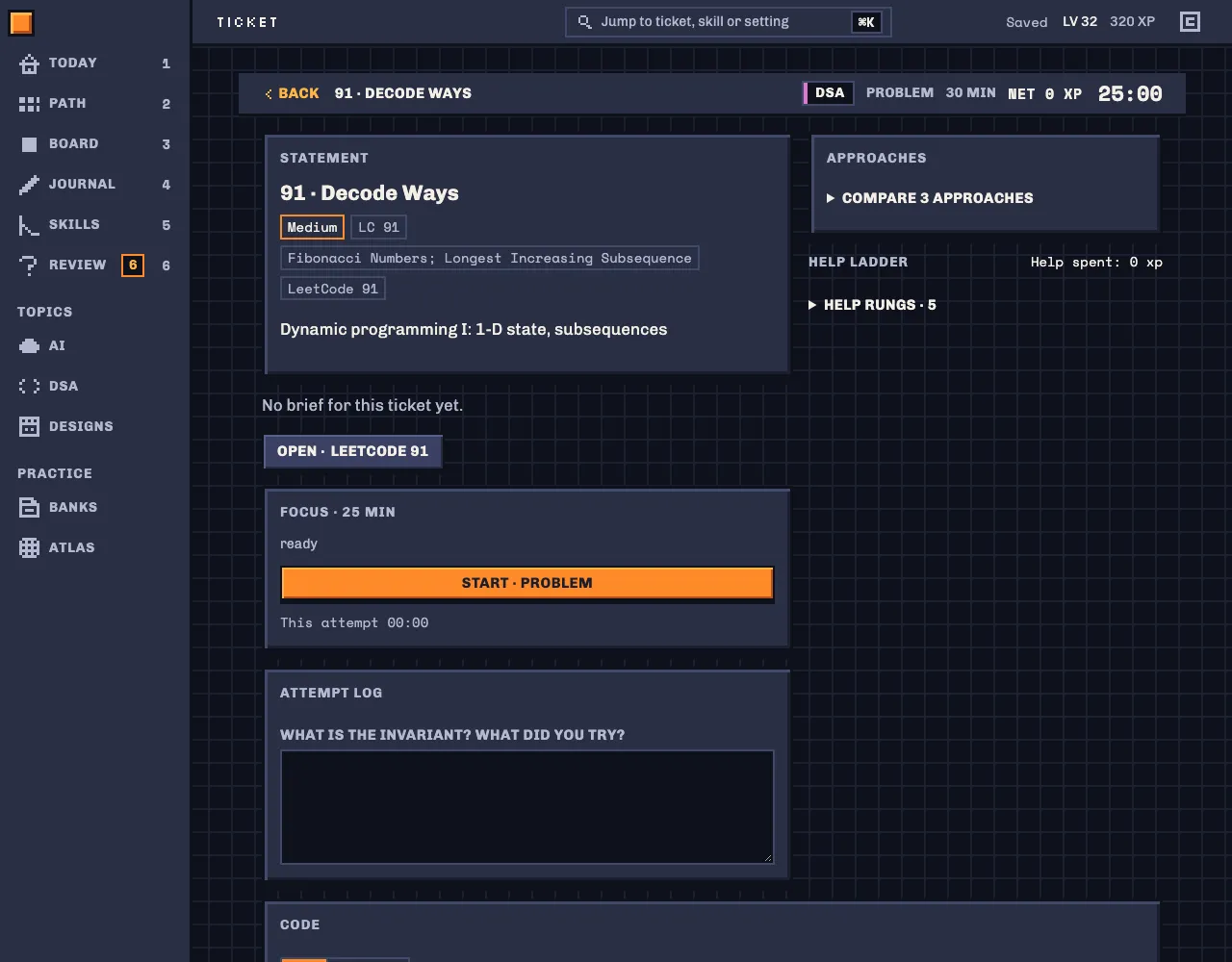
One study ticket with three answers, graded the moment you pick one, plus a four-item queue you can reorder by dragging or with the up and down buttons.
Problem
A months-long study plan tends to fail around week six. You open it and cannot tell what to do today. The plan is still there, but it is too big to act on, so you skip a day, then a week.
I wanted a study tool that answers one question each morning: what is the one thing to do now. It also had to keep my notes and progress on my own machine, because I did not want a study history living on someone else's server.
Constraints
- Local-first. Data is one SQLite file in
~/Dojo, never in the repo (dojo README, 2026-10-24). - A macOS desktop app, so Electron, with web tech inside.
- Code practice has to run and grade solutions without a server, so Python is graded in the browser with Pyodide.
- AI help is optional. When it is on, it goes through the user's own Claude Code login, so the app holds no API keys of mine.
- The study content I use is personal. The public build ships a generic sample plan and empty bank packs, and a release scrub runs before anything is published.
Approach
The core screen is Today: one ticket, with a reorderable queue behind it. A ticket can be a problem, a reading or a design exercise, and it carries a focus timer, an attempt log and, for code, a panel that runs and checks your solution.
Content is not hard-coded. A plan JSON describes the schedule and a bank-pack system holds the study material. There are two editions: a private plan with my own banks, and a public edition with the generic sample plan.
Publishing is a pipeline, not a copy. scripts/public-extract.mjs writes the public tree from the private build and runs the release scrub on it. npm run publish:public builds and tests that copy, shows the changes and pushes to public main only after I confirm.
The look comes from Still Room. src/styles/tokens.css and src/ui/Glyph.tsx use its tokens and glyphs (Dojo (private build), 2026-10-24).
What shipped
- Public releases v1.0.0 (the first, a build-from-source release, 2026-10-07), v2.0.0 (the flat queue, 2026-10-15), v2.1.0 (labs, Proven and Portfolio), v2.2.0 (Release 3, Pages, Phase 2) and v2.2.1 (2026-10-18) (Dojo (private build), 2026-10-24).
- Six places in the rail: Today, Path, Board, Journal, Skills and Review. Under them are Topics (AI, DSA and Designs) and Practice (Banks and Atlas) (Dojo changelog, v2.0.0).
- Code panels with Go and Python, test cases and a step-through trace of the algorithm, so the panel shows why a solution works, not only that it passed.
- A board for the sprint and a journal where each study item gets a difficulty and an explain-without-notes check.
- The public repo is MIT licensed at
github.com/pratikgh0se/dojo.
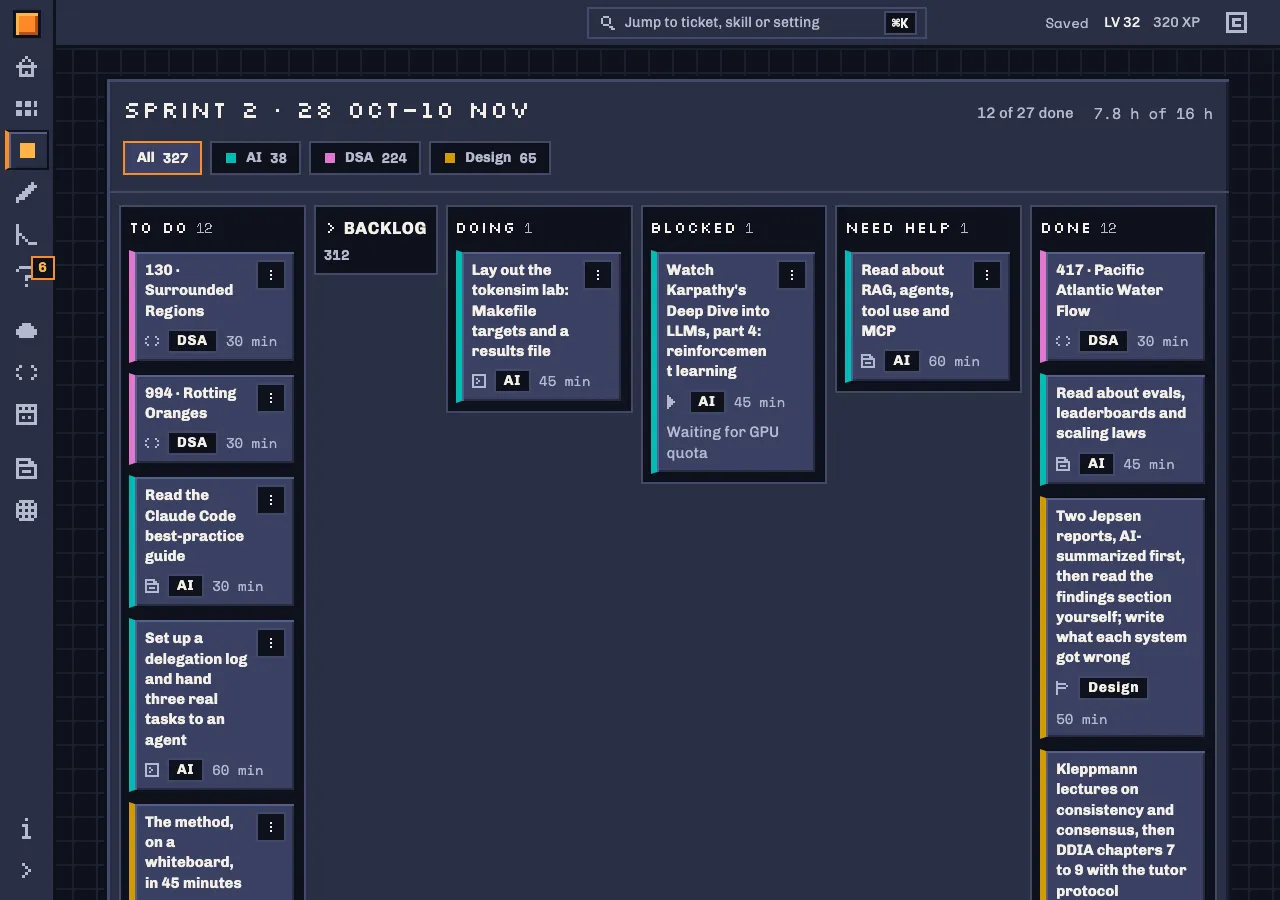
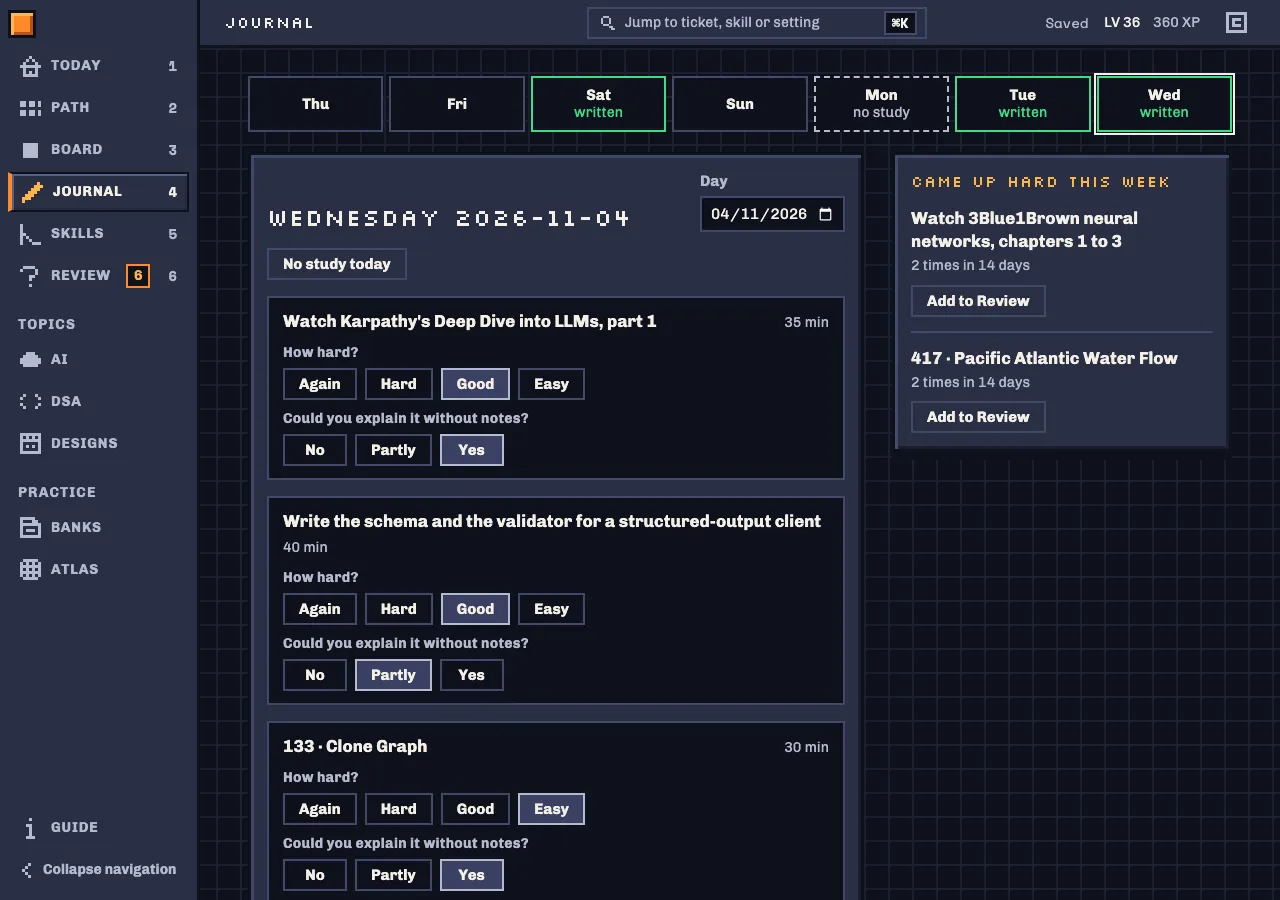
The screenshots show the generic sample content that ships with the app, not my own study data.
Outcome
The private build has 1,587 commits between 2026-09-27 and 2026-10-17 (git log, Dojo (private build), 2026-10-24) and 575 real test files (Dojo (private build), 2026-10-24). I started using it for my own study on 2026-10-06 (vault Intake board).
What I learned
Keeping the private and public editions apart had to be a gate, not a habit. During the 2026-10-16 UAT run, a private internal host name got past the leak check. The fix was a new host rule in the scrub, so the check now catches private host names and private IP ranges (PORT-53).
Real use also beat my test runs. On 2026-10-05 the app took 4 to 5 seconds per click. The cause was my machine at load average 33 from parallel agents, and a quiet-machine run then found the actual bugs (vault Dev Logs 2026-10-16, 2026-10-05 and 2026-10-11).
How AI built this
I built Dojo with Claude Code.
- Code-blind tests. For Release 1 and Release 2, the acceptance tests were written from numbered contract clauses by an agent that never saw the app code. They live in a separate private repo (761 tests), and only a results file flows back. Release 1 went from 275 of 317 passing to 366 of 369 over seven blind runs, and the Release 2 candidate reached 775 pass, 0 fail, 7 fixme. An earlier black-box suite (725 tests) and real-cursor UAT runs were also written from contracts without reading the app. The counts come from the repos' READMEs and a grep, not a fresh test run (as of 2026-10-25).
- Models. Opus orchestrated and reviewed every merge. Sonnet built and fixed. Haiku ran the blind suites, fact-checks and computer-use UAT in Release 2. Sonnet ran the earlier real-cursor lanes (vault Dev Logs, 2026-10-07 to 2026-10-16).